Did You Know?...
HEALTHY WETLANDS DEVOUR MOSQUITOES
SURPRISE
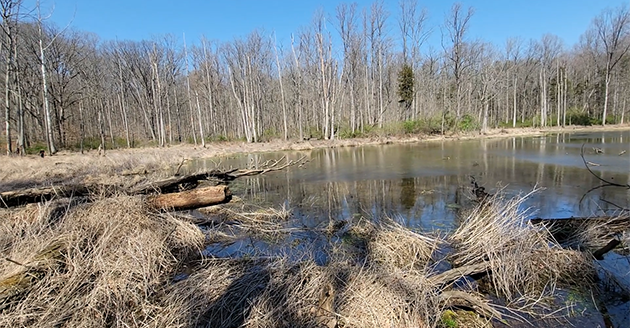
Contrary to popular belief, healthy, functioning wetlands can actually reduce mosquito populations.
BUT EVERYBODY SAYS ...
Mosquito control programs commonly recommend that wetlands be drained in order to
control mosquitoes. This is because mosquitoes require standing water to breed, and if
there is no standing water, there will be no mosquitoes. Quite true. However, mosquitoes
have a very short life cycle (from 4 days to a month), and their eggs can remain dormant
for more than a year, hatching when flooded with water. Therefore, even after a wetland
has been drained, it may still hold enough water after a rain to breed mosquitoes. The
drained area may actually produce more mosquitoes than it did when it was a wetland!
HEALTHY WETLANDS VERSUS WET AREAS AND STANDING WATER
A healthy wetland provides habitat for many unique animals including natural enemies of mosquitoes. These natural predators keep the mosquito population low. Mosquitoes become a problem, however, in areas that have standing water, yet do not Support the beneficial animals that feed on mosquitoes. Most any kind of wet area or standing water makes a good breeding site for mosquitoes: old tires, cans, and other containers that collect rainfall; even hollow logs that hold water and low spots in the ground where water pools. And because these types of places do not provide good homes for those beneficial insects and other kinds of wildlife that feed on mosquitoes, the mosquitoes, quickly reproduce out of control.
THE BALANCE OF NATURE
Mosquito populations are held in wetlands. Certain birds, frogs, fish, and insects live
in these wetlands and feed on mosquito larvae and/or adults.
The following insects are natural enemies of mosquitoes: Dragonflies, Damselflies,
Water Strays, Backswimmers, and Predacious Diving Beetles.
But these insects need proper habitat (healthy wetlands) to survive. You won't find them in the typical areas where mosquitoes thrive - small spots of open, standing water and other wet areas where mosquitoes can become thick as fog.
REDUCE MOSQUITO POPULATIONS RESTORE A WETLAND!
Wetland restoration decreases mosquito populations in two ways: by providing proper habitat for the natural enemies of mosquitoes, and by preventing or reducing flooding (in areas that aren't normally wet and thus support mosquitoes but not their predators). When the Essex County Mosquito Control Project restored a 1,500 acre wetland in Massachusetts, the mosquito population dropped by 90 percent. The experts there know that wetland restoration is synonymous with genuine mosquito control (Audubon Magazine, November-December 1996). And in Indiana, the most serious mosquito problems tend to occur in flood-waters and woodland pools. So by restoring healthy wetlands, we really can do ourselves and all Hoosiers a big favor!
MAKE A LASTING IMPROVEMENT
If you own or manage drained wetlands, you can expect "blooms" of mosquitoes after every rain. If you're tired of donating blood, consider restoring or creating a healthy wetlands Within days, natural predators of mosquitoes will begin to return. Not only will you be reducing the mosquito population, you'll also be creating excellent wildlife habitat, reducing the likelihood of flooding on adjacent ground, improving water quality, and possibly other benefits as well.
QUICK FIX
If you've determined that you really need a "quick fix" for your mosquito problem, at least try to use the more environmentally friendly methods.
Here are two:
- Bacillus thuringiensis isruelensis (Bti) is a bacterium that can be used in almost any aquatic habitat with no restrictions. It is fast acting and quickly biodegrades. The timing of its application is critical to its effectiveness.
- S-methoprene is a synthetic mimic of an insect hormone. It is safe for workers and degrades into simpler compounds.
Remember that these methods are not permanent or long lasting, but must be repeated for effective control.
SMART ECONOMICS
It pays to control mosquitoes in an environmentally friendly way. New Jersey has been controlling mosquitoes "the natural way" by using a technique called Open Marsh Water Management (OMWM). This. technique controls mosquito larvae elimination breeding depressions (low areas where water pools) and by increasing natural enemies of mosquitoes, insecticides are not used. The Cap May County Mosquito Extermination Commission reported spending approximately $16,000 to implement the OMWM method on a 548-acre marsh in 1969. This was a one-time expense because 25 years later, the marsh still had not needed maintenance, cleaning, or pesticides. The Commission estimated that the cost to use traditional insecticide method (repeatedly treating the area with chemicals) over the same period would have been $685,000. OMWM resulted in a savings of $669,000 - over 97 percent! (www.umaa.org/ecomosco.htm)
In a separate economic study, The Commission compared a range of costs for OMWM with the cost of traditional larvicide, methods for the estimated 20-year life of the OMWM method. The cost ranges for OMWM were $5 to $63 per acre. The cost of using larvicide was $286 per acre. OMWM resulted in a savings of from $222 to $280 acre, or 78 to 98 percent! (The Economics of Marsh Water Management, a New Jersey View, Proceedings of the 63rd Annual Meeting, NJ Mosquito Extermination Association.)
FOR MORE INFORMATION
To see if you have a restorable wetland on your property, contact the
Indiana Department of Natural Resources.
IDNR Division of Fish and Wildlife
Room W273 I.G.C.S.
402 West Washington Street
Indianapolis, IN 46204
317-232-4080
Or contact your local Soil and Water Conservation District. Call 317-692-7325 to get the phone number of your local SWCD office.
OTHER MATERIALS
BMPs for Mosquito Control and Freshwater Wetlands Management
New Jersey Office of Mosquito Control Coordination
P.O. Box 400
Trenton, NJ 08625-0400
Phone: 609-292-3649